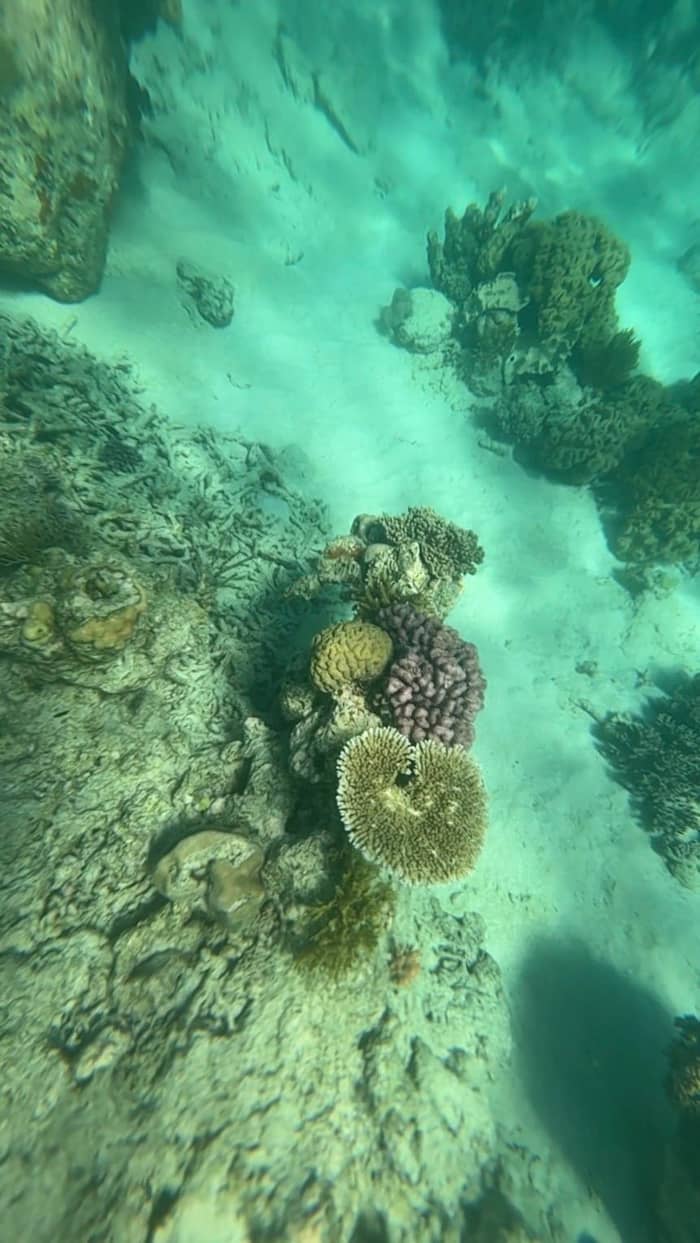
Catamaran day
Cairns, outer reef
Our listing
- Whole trip9 hours
- Reef sites2 outer locations
- LunchChef-prepared buffet
Guides
Language
Currency
Check datesfrom $193 · cancelling is freeMake-your-mind-up tool
Brief answer
The Great Barrier Reef is a Marine Park of 344,400 square kilometres stretching approximately 2,300 km along the Queensland coast, and it was declared a World Heritage Area in 1981.
Key figures
Two taps to a reef day
Say how much time you have and what you want most, and a matching listing appears with its from-price.
Your top pick
from $125
It lasts 4 hours and has 1,768 reviews rated 4.73.
Your top pick
from $468
It runs 2 days and limits the group to 12 participants.
Your top pick
from $193
It runs 9 hours to 2 outer reef locations and has 3,767 reviews.
Your top pick
from $223
It runs 8 hours and has 837 reviews rated 4.95.
Your top pick
from $200
It runs 7.5 hours and is wheelchair accessible.
The reef is a marine park, a World Heritage Area and a living structure at once. Here are the figures that matter, from the 2,300 km length to the part you can reach on a day trip.
Editorial team, greatbarrierreeftour.quest · Updated November 7, 2026 · 7 mins to read
In brief
The Great Barrier Reef is not a single wall of coral. It is a managed marine park made up of thousands of separate reefs, and the Marine Park covers 344,400 square kilometres.1 It was created in 1975 through the Great Barrier Reef Marine Park Act, and it takes in the world's largest coral reef ecosystem.6,7 Anyone asking what the Great Barrier Reef is will get the most useful answer from that mix: a protected zone of ocean, reefs and islands rather than one object you can point to.
The Reef Authority describes the reef as about 10 per cent of the world's coral reef ecosystems and one of the best known and most complex natural systems on Earth.8 It is both a Marine Park and a World Heritage Area, and it draws millions of visitors each year who come to enjoy it above and below the water.9 Those two labels do different jobs for a traveler: the park is where the rules and the zoning apply, and the heritage listing is where the reef's global value is recognized.
Coral is the headline, though it is a small share of the whole. Coral reefs make up only about 7 per cent of the Marine Park, while the rest is a wide range of habitats from shallow seagrass and mangroves to deep ocean.10 Keep that in mind as you read the figures below. A statement about the reef can be true of one place and unremarkable at another, and the facts that help are the ones tied to a place you will actually visit.
The numbers
| Measure | Figure | In context |
|---|---|---|
| Marine Park area | 344,400 sq km1 | Bigger than Victoria and Tasmania combined2 |
| Length along the coast | 2,300 km3 | Over 14 degrees of latitude16 |
| Width | 60 to 250 km17 | Varies along the coast17 |
| Coral reefs | About 3,0004 | Only about 7 per cent of the park is coral reef10 |
| Islands and cays | 105021 | 600 continental and 300 coral cays4 |
| Hard coral species | Around 45022 | Plus a large group of soft corals22 |
| Fish species | Over 150023 | Plus over 4000 species of molluscs23 |
| Heritage listing | 19815 | 348,000 sq km World Heritage Area24 |
All figures are the Reef Authority's, taken from its fact page and its World Heritage page.1,24
The reef is long, and its length is the figure people reach for first. The Marine Park stretches approximately 2,300 km along the coast of Queensland.3 It runs from the northern tip of Queensland to just north of Bundaberg, and it extends over 14 degrees of latitude.15,16 Few places on Earth can be described by the span of latitudes they cover, and this is one of them.
Width varies a great deal along that length. The Marine Park is between 60 and 250 kilometres wide, so a boat heading east from the coast can be crossing reef for a long time before it reaches the open Coral Sea.17 Depth changes just as sharply. Inshore waters average 35 metres deep, while on the outer reefs the continental slopes fall to more than 2,000 metres.18 That drop is why the outer edge feels like a different world from the shallows near the shore.
Comparisons help with scale. The Reef Authority says the Marine Park is bigger than Victoria and Tasmania combined, and that Mount Fuji could be stacked end to end 609 times along the reef.2,19 Against other barrier reefs the gap is wide: the Belize Reef is the second longest in the world at 290 km, and Ningaloo Reef on the West Australian coast is 280 km long.20
Count the parts and the reef starts to look like a country. The Marine Park includes some 3,000 coral reefs, 600 continental islands, 300 coral cays and about 150 inshore mangrove islands.4 Across the wider World Heritage Area the Reef Authority counts 1050 islands and cays, the high islands and the sandy cays together with the mangrove islands that help the whole system function.21
These types behave differently, and a visitor meets them differently. The Reef Authority separates the continental, or high, islands from the coral cays, which are at various stages of formation, and from the mangrove islands inshore.4 A day boat from Cairns does not stop at any of these. It heads for the outer reef, where an operator describes a pontoon far enough from coastal rivers, streams and sandy beaches for clear ocean water, at approximately 45 km offshore.26
The reef is also a record. The Reef Authority notes that its environmental history is written into the reef structure, and that old massive coral cores show climate conditions over many hundreds of years.27 The part of the reef you see on a snorkel is a thin living layer on a structure that has been growing for a very long time, which is worth remembering the next time a guide points at an old coral head.
Meeting the reef
Catamaran day
Our listing
Further north
Snorkeling cruise
Whitsundays
Adventure cruise
Life on the reef is counted in species, and the numbers are large. There are around 450 species of hard corals living on the reef, alongside a large group of soft corals.22 Corals look like plants and are in fact marine animals, closely related to jellyfish.30 Hard corals pull calcium from seawater to make the limestone skeletons that form coral reefs, so the reef is physically built by animals.31
Beyond coral, the World Heritage Area is listed for over 4000 species of molluscs and over 1500 species of fish.23 It is habitat for one of the most important dugong populations and for six of the seven marine turtle species.32 Raine Island is the largest green turtle breeding area, and the reef is a breeding area for humpback whales, with at least 30 other species of whales and dolphins identified there.33,34
Plants and habitats count too. The World Heritage Area includes about 39 species of mangroves, which is 54 per cent of the world's mangrove diversity.35 On a boat day the wildlife you notice will be turtles, fish and coral, but the reef also depends on all of this less visible life. A fact sheet that stops at coral misses most of the picture.
The reef over time
1975
The park was created through the Great Barrier Reef Marine Park Act.6
1981
The Reef was declared a World Heritage Area in 1981.5
2016 and 2017
The Reef had 2 consecutive years of mass bleaching, in 2016 and 2017.11
2024
The 2024 event affected all regions of the Reef.12
2025
A less extensive mass bleaching event occurred.13
2026
Hard coral cover stayed stable or increased across much of the Reef.14
The reef was declared a World Heritage Area in 1981.5 The World Heritage Area covers 348,000 square kilometres, bigger than the United Kingdom, Holland and Switzerland combined, and about 99 per cent of it lies within the Marine Park.24,36 The two names describe almost the same water, one by management and one by global recognition.
People are part of the listing. The reef is sea country for more than 70 Traditional Owner groups, whose connections to the marine environment go back more than 60,000 years.37 That history is easy to overlook on a brochure page about snorkeling, and it is part of why the reef is more than a nature reserve. The cultural value sits next to the ecological one in the heritage record.
The economy is part of the story as well. A Deloitte study quoted by the Reef Authority values the reef at $95 billion across economic, social and cultural dimensions, and says it contributes $9 billion a year to the Australian economy and supports 77,000 full-time jobs.25,38 Tourism is the largest contributor, at $7.9 billion a year.39 Your ticket is one small piece of that total.
Video
Beautiful World - Documentaries on YouTube · The video waits until you tap play to load.
The Great Barrier Reef makes up about 10 per cent of the world's coral reef ecosystems and is one of the best known and most complex natural systems on Earth.
Before you quote a number
Almost none of those 344,400 square kilometres is visited on a typical day.1 Tourism is concentrated into about 7 per cent of the reef area, and the Cairns and Whitsunday planning areas account for more than 86 per cent of tourist visits.40,41 Tourism visitation to the whole Marine Park in 2023 was approximately 2.13 million total visitor days.28 That puts the reef you see on a trip in context: a well-managed corner of a very large system.
From Cairns, the usual way in is a day boat to the outer reef. The listing behind this site is a premium catamaran day from the Reef Fleet Terminal, lasting about 9 hours, with 2 outer reef locations picked by the crew on the day between the Flynn and Milln reefs and the more northern Norman and Hastings reefs. The itinerary lines give 2 hours of snorkeling or diving at the first stop and 1.5 hours at the second.
It starts from $193, with free cancellation up to 24 hours before for a full refund, and it holds 3,767 reviews rated 4.8. The other pages of this guide go deeper on how the reef formed, why it matters, whether it is dead, where it lies and what trips cost. Prices and open dates stay live on the booking panel on the home page.
FAQ
The Marine Park also holds 600 continental islands, 300 coral cays and about 150 inshore mangrove islands.4
Coral reefs make up only about 7 per cent of the Marine Park, and the rest is other habitats such as seagrass and open ocean.10
The listing on this site visits 2 outer reef locations picked on the day, in a trip of about 9 hours.
Sources
Questions about the reef from Cairns? A real person answers here.